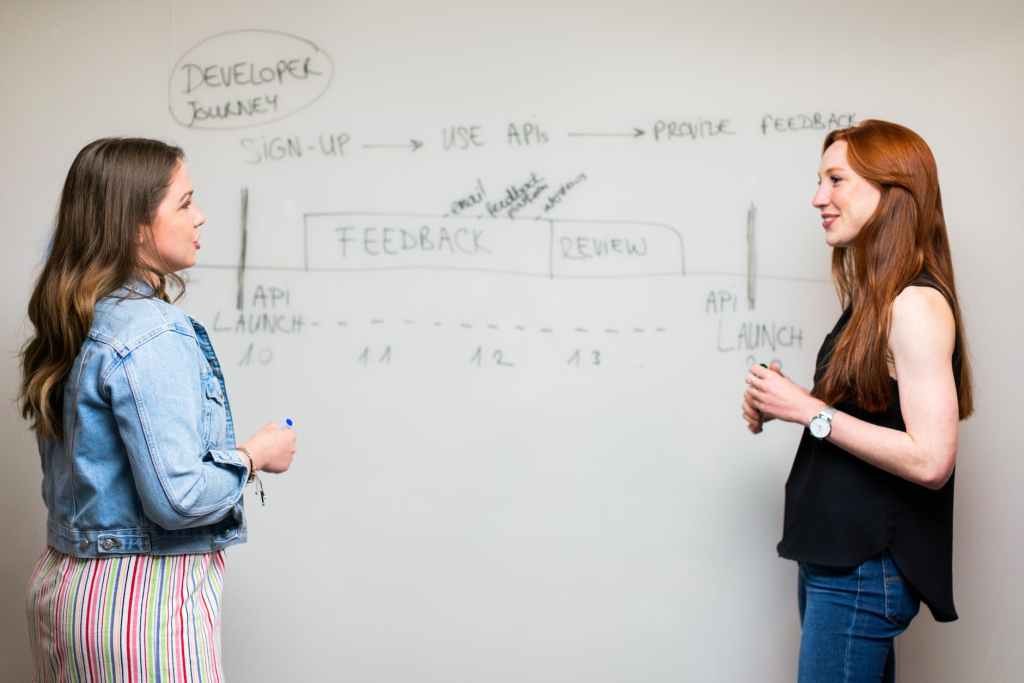
Accountability: anything or anyone that helps you gain mental leverage to achieve the results you desire. —The Accountability Stop
When I was a teenager, I wanted to write a musical. But I didn’t think I could finish one on my own. I wanted a writing partner. I wanted a lyricist to write the words and I would write the music. We would be like Tim Rice and Andrew Lloyd Webber, Claude-Michel Schönberg and Alain Boublil, or Alan Menken and Howard Ashman.
In retrospect, I actually didn’t need a lyricist partner. I needed an accountability buddy. In brief, an accountability buddy or partner is someone you talk with regularly about your projects or goals. You also listen to their goals and hold them accountable to accomplishing them. It’s permission-based. You give each other permission to know and check in on your goals, with full equality. Neither one of you is “the boss.” Entrepreneurs are frequent accountability buddy seekers, because they don’t have a boss to report to. But you can use accountability buddies for personal, creative, or habit goals as well.
A search for “accountability buddies” will get you plenty of hits if you’d like to dive deeper. I’ve never made a formal study of it, so I won’t write an academic treatise on them here. Instead, here are my experiences with accountability buddies.
Parents
Parents are terrible accountability buddies! At least in my experience. My parents were never very good at understanding my frustrations or challenges. (They’re both Myers Briggs ISTJs and I’m an INTJ, if that tells you anything.) They just told me to get over it and do my work, whatever my work might be. A mental block was a completely alien concept to them. I learned early on that sharing my personal goals with the parents was usually counterproductive.
Aside from the personality mismatches in my childhood. Parents and children inherently have an unequal relationship. One would have to have a very healthy relationship with one’s parents to be each other’s accountability buddy. Parents have a tendency to be the boss whether they intend to or not. A parent’s attempt to encourage may come across to even adult children as nagging.
Do Your Homework
Good homework buddies are kind of an accountability relationship. I had a group of homework buddies at engineering school who were great to work with. But oddly, our friendship was built around homework. I found that out after college when one of my homework buddies and I tried to get together as friends. He didn’t want to talk about work. And suddenly I felt like we didn’t have a thing to talk about. The work, the classes, and the crazy deadlines were what had fueled our friendship. When we didn’t have that any more, it seemed like we couldn’t be friends.
Good accountability buddies are not necessarily good friends. And vice versa—it’s difficult to focus on a few goals and talk about them when you can talk about literally anything with your friends.
Accountable Roommates
In college I was randomly paired up with a roommate. We turned out to be great accountability buddies for each other. We were both musicians majoring in engineering. We both played piano and wrote music. We were both imaginative and intelligent, but also goal-oriented and driven to accomplishment. We took on multiple extra-curricular music and church projects fueled almost entirely by the dynamic of our relationship. I didn’t know what accountability buddies were at the time. We were just having fun. He and I worked through lots of challenges and obstacles naturally, without really thinking about it.
Having similar interests, temperaments, and—well—levels of intelligence is helpful.
Arranged Buddies
Several years ago, I joined an online group that included optional accountability matchmaking. It was my first time formally having an assigned stranger as an accountability buddy. I’m not sure how much information they were really able to work with to match-make.
My first accountability buddy didn’t spark for either of us. We had similar interests, but definitely not temperaments. He was years younger than me and still figuring life out. Nothing wrong with that, of course. I was well-established in my career and life. We were better suited for a mentor/mentee relationship than accountability buddies. We mostly emailed. After only a few emails back and forth he stopped responding.
Similar ages and levels of maturity/development are helpful too.
The second accountability buddy assigned to me, I found out later, had specifically requested me. (This may be the only recommendation I can offer from anyone that I’m qualified to write this blog!) She was several time-zones away. We created a unique way of checking-in daily. We logged our various projects and habits in a shared Google sheet. It included cells for comments back and forth to each other. It worked really well for both of us for several years.
Occasionally we scheduled an online chat. It might have been me, but it seemed like we didn’t quite click in person. While we had similar creative and project goals, she was a wife and mom. I’m a single guy. Our politics aligned, but she was more intense about it. The Great Disruption of 2020 finally put us on a pause and we floated apart. We’re still friends and check in occasionally.
Organic Accountability
My current accountability buddy and I met in the same online forum through informal chatting. He’s had a fascinating life journey that took him around the world. We got together in person a couple of times and seemed like we both naturally offered advice and encouragement to each other about projects, work, and life. At some point I asked, “Do you want to talk more often?” He was enthusiastically agreeable to that.
Our approach includes weekly video chats to review goals and progress. We’ll also schedule 3-hour blocks of time on weekends when we’ll work on our projects simultaneously and check in every hour. It’s a hybrid of accountability buddy and the pomodoro technique that I mentioned previously.
In my current accountability relationship, we’re both good at gently but directly calling out excuses and resistance. We talk about what resistance we have and how we might get around it. We’re both cognizant about trying not to nag.
As with other accountability techniques, accountability buddies aren’t a sure bet. It’s worth trying out the process and seeing whether it works for you. I highly recommend buddying up!
What’s Your Account?
Have you ever had an accountability buddy or partner? What was your interaction? How did you (or do you) like the process?
 The Accountability Stop
Leave a comment