
Accountability: anything or anyone that helps you gain mental leverage to achieve the results you desire.
—The Accountability Stop
As I continue to write articles about accountability techniques, I’m struck by how often accountability, goal achievement, and habit formation come down to one word:
When
This isn’t a monumental revelation. We’ve talked about appointments before. Time is the key component to doing anything. We must put in the hours. A book could literally take years to write. Learning French doesn’t happen overnight.
On a manager level at my day job, complaints abound that our engineers don’t adhere to the fundamentals, don’t have others check their work, and don’t document their work. I regularly propose the only appropriate solution I can: we must set aside time to meet as a company and reinforce the fundamentals, the importance of documentation, and the need for quality checking. This meets with a wall of managerial resistance. No one wants to (a) take time out of producing work to discuss process or (b) take responsibility for actually discussing process. We spend time complaining how important it is, but we won’t invest the time required to improve.
When we’re looking for an accountability method that will work for us, what we’re really looking for is a way to hold our commitment to do our work when we say we’re going to do it.
I’m dipping into productivity again, but consider the Eisenhower matrix:
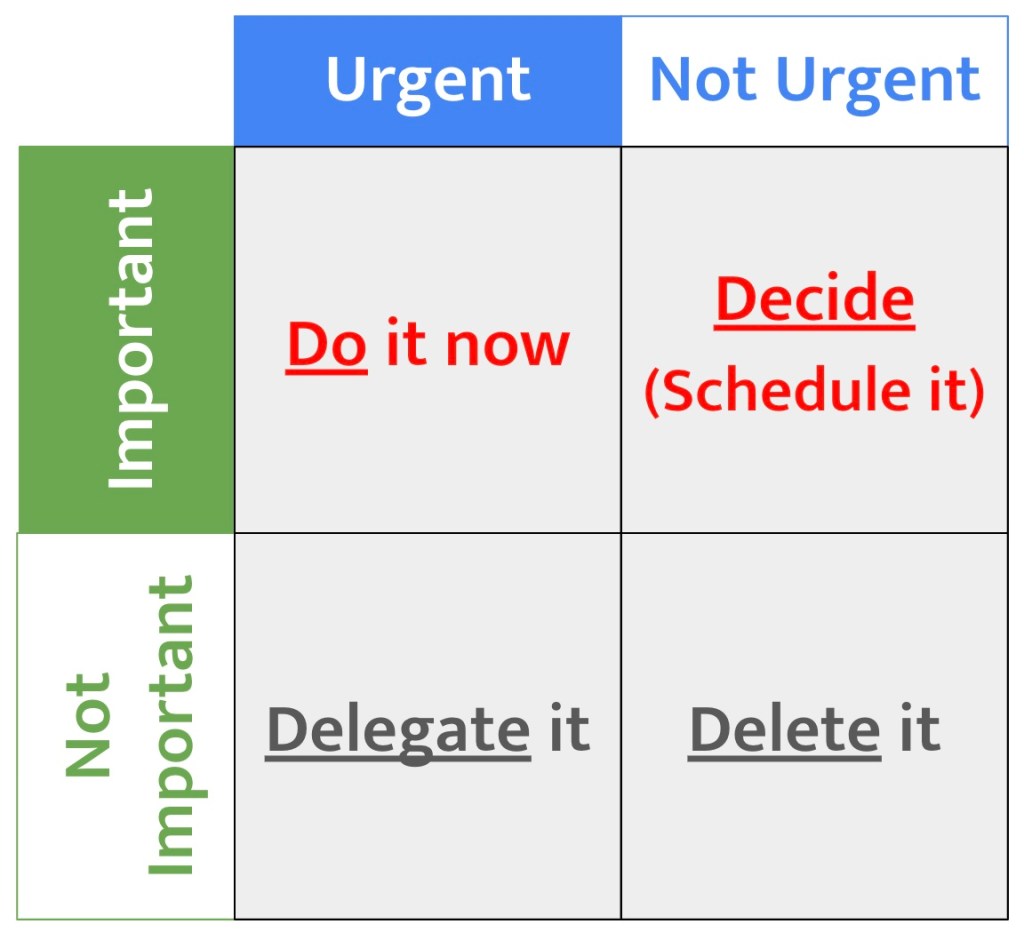
The Eisenhower matrix categorizes tasks in two ways – is it important, and is it urgent? Depending on how you rate your tasks on those two axes, the matrix tells you how to treat the task.
Most of our personal accountability goals — the “want to’s” of our lives as opposed to the “have to’s” — fall into the not urgent and important category. They are important to us, even if we don’t think they’re ever important enough to become urgent.
Consequently they must be scheduled. We need to make time for goals to happen. We might have to take what seem like drastic measures: tell our partner to have a night with their friends and ask our sister watch the kids. Stop at the library for an hour after work to spend time writing our book. Get up an hour earlier, meditate, and learn Spanish. Sometimes even turning off the TV and phone and giving up those “down-time” hours to do more work feels like a big effort.
Those things are hard to do. They require engagement. Grabbing our schedule by the horns and making it work for us can feel Herculean. That’s why personal accountability is so important. We need that extra promise, that extra leverage outside ourselves to make us harness the power of when.
What’s Your Account?
Do you feel like you control your schedule, or your schedule controls you? Are there parts of your day that are wasted and could be used for your goals? (Not to point fingers, but you did spend the time to read this whole article!)
 The Accountability Stop
Leave a comment